
Dog Training Certification Program
How to Choose the Right Path and Build Professional Training Skills
Choosing a dog training certification program can feel overwhelming. There are countless courses, certificates, online programs, workshops, and schools claiming to prepare you for a career working with dogs. How do you know which ones actually teach useful skills?
Whether you want to become a professional dog trainer, improve your understanding of canine behaviour, or eventually work with difficult cases such as reactivity, aggression, anxiety, or poor recall, the quality of your education matters.
At mydogtrained.com, we believe effective dog training starts with understanding the dog rather than simply controlling the behaviour. A good training education should teach you how dogs learn, how to communicate clearly, how to identify the reason behind unwanted behaviour, and how to create practical training plans that owners can actually follow.
This guide explains what to look for in a dog training certification program, what you should learn, common mistakes to avoid, and how to turn your education into practical training experience.
What Is a Dog Training Certification Program?
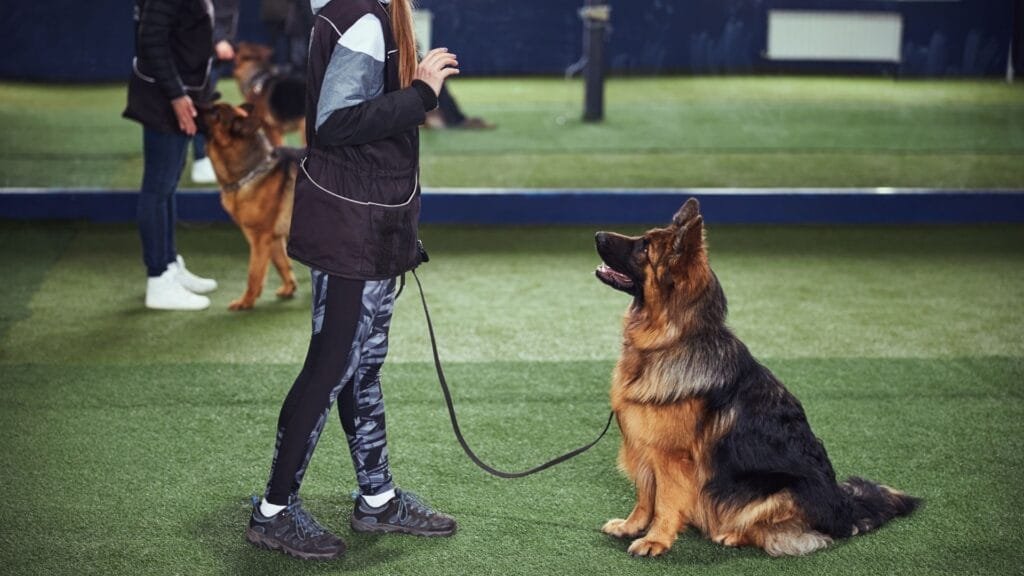
A dog training certification program is an educational course designed to teach students the principles, techniques, and practical skills needed to train dogs professionally.
Programs vary enormously.
Some focus primarily on basic obedience, while others cover canine psychology, behaviour modification, puppy development, aggression, fear, learning theory, business management, and working with dog owners.
A quality program should help you understand:
- Canine body language
- Learning theory
- Positive reinforcement
- Reward timing
- Motivation
- Leash handling
- Basic obedience
- Puppy training
- Recall training
- Loose-leash walking
- Reactivity
- Fear and anxiety
- Behaviour modification
- Training-plan development
- Dog-owner communication
- Training ethics and safety
The certificate itself is only one part of the equation.
Practical competence matters far more than a piece of paper.

Why Choosing the Right Dog Training Certification Program Matters
Imagine working with a dog that lunges at every dog it sees.
You could simply tell the owner to correct the behaviour. But that does not answer the important question: why is the dog lunging?
The behaviour could be related to fear, frustration, excitement, previous experiences, poor socialisation, lack of impulse control, or several factors combined.
A professional trainer needs to investigate before choosing a solution.
That is why a strong dog training certification program should teach you to observe behaviour and develop an appropriate training strategy rather than simply handing you a list of commands.
You Need More Than Basic Obedience Skills
Teaching sit, down, and stay is relatively straightforward.
Professional training becomes much more complicated when the dog is frightened, overexcited, reactive, aggressive, distracted, or unable to focus.
Your education should therefore progress from simple skills to increasingly complex situations.
What Should a Dog Training Certification Program Teach?
Before enrolling, examine the curriculum carefully.
A comprehensive program should cover several important areas.
1. Canine Learning Theory
You need to understand how dogs learn.
Important concepts include:
- Reinforcement
- Punishment
- Classical conditioning
- Operant conditioning
- Reward timing
- Motivation
- Consequences
- Generalisation
- Desensitisation
- Counterconditioning
You do not need to become an academic psychologist, but you should understand the practical application of learning principles.
2. Canine Body Language
Dogs communicate constantly through their bodies.
A trainer should recognise signs such as:
- Lip licking
- Yawning
- Turning away
- Stiff posture
- Whale eye
- Tail position changes
- Ear position
- Freezing
- Avoidance
- Play behaviour
- Relaxed body language
Understanding these signals can help you identify stress before behaviour escalates.
3. Basic Obedience Training
A solid program should teach you how to train fundamental behaviours such as:
- Sit
- Down
- Stay
- Come
- Leave it
- Drop it
- Place
- Wait
- Loose-leash walking
But the emphasis should be on how to teach these behaviours rather than simply memorising commands.
How to Build a Professional Dog Training Session
Once you understand the theory, you need to learn how to structure a training session.
A simple framework works well.
Step 1: Identify the Training Goal
Do not begin by randomly practising commands.
Decide exactly what you want the dog to learn.
For example:
“I want the dog to remain calmly beside the handler while another person walks past.”
That is much more useful than simply saying, “We are going to work on obedience.”
Step 2: Control the Environment
Training becomes much easier when the environment matches the dog’s current ability.
Start with fewer distractions.
You might begin:
- Inside the home
- In the backyard
- In a quiet outdoor location
- In a moderately distracting environment
- Around controlled distractions
- In increasingly difficult real-world situations
This gradual progression helps prevent the dog from becoming overwhelmed.
Step 3: Choose an Appropriate Reward
Rewards are not limited to food.
Depending on the dog, reinforcement might include:
- Small food treats
- Toys
- Praise
- Play
- Access to something interesting
- Sniffing opportunities
- Freedom to move
A professional trainer learns what motivates each individual dog.
Step 4: Mark the Desired Behaviour
Timing is critical.
When the dog performs the desired behaviour, immediately communicate that it was correct.
A marker such as “Yes!” can be useful.
Then provide the reward.
The sequence should be:
Behaviour → marker → reward
The closer the reward is to the desired behaviour, the easier it is for the dog to understand what earned it.
Step 5: Increase Difficulty Gradually
One of the biggest training mistakes is making things difficult too quickly.
If your dog can perform stay for 10 seconds in the kitchen, that does not mean it can automatically perform a 10-minute stay at a busy park.
Increase difficulty gradually by changing variables such as:
- Duration
- Distance
- Distractions
- Location
- Handler position
Change one variable at a time whenever possible.
Dog Training Certification Program and Behaviour Problems
A professional-level education should go beyond obedience.
Dogs can develop behavioural problems for many reasons.
Reactivity
A reactive dog may bark, growl, lunge, or become highly excited when seeing another dog, person, vehicle, or environmental trigger.
Training should begin by identifying the dog’s threshold.
If the dog is already exploding at the end of the leash, learning is usually much harder.
Instead, work at a distance where the dog can notice the trigger while remaining capable of responding to the handler.
Reward calm behaviour.
Gradually decrease the distance only when the dog is consistently successful.
Separation-Related Problems
Dogs that struggle when left alone require a carefully structured approach.
Simply telling the owner to “ignore the dog” is unlikely to solve a serious separation-related problem.
A trainer should understand gradual absences, emotional responses, environmental management, and when referral to a veterinary professional or qualified behaviour professional is appropriate.
Aggression
Aggression should always be taken seriously.
A responsible trainer should prioritise:
- Safety
- Trigger management
- Appropriate equipment
- Risk assessment
- Behaviour history
- Veterinary considerations
- Controlled training environments
- Professional referral when necessary
Do not treat aggression as simply an obedience problem.
Common Mistakes When Choosing a Dog Training Certification Program
Not every course provides the same level of education.
Watch for these warning signs.
Choosing a Program Because It Is Cheap
Price should not be your only consideration.
A very cheap program may provide little practical education.
Look at:
- Curriculum depth
- Instructor experience
- Practical training requirements
- Assessment methods
- Behaviour content
- Student support
- Continuing education
Focusing Only on the Certificate
A certificate does not automatically make someone an excellent trainer.
Experience matters.
You need to practise reading dogs, delivering instructions, timing rewards, modifying training plans, and communicating with owners.
Learning Only One Training Method
Dogs are individuals.
A good trainer should understand the science behind different training concepts and know how to adapt techniques responsibly.
Avoid programs that present complicated behaviour as though one technique fixes everything.
Ignoring Human Behaviour
You are not just training dogs.
You are training people to train their dogs.
Owners need instructions they can understand and reproduce at home.
A technically brilliant training plan is useless if the owner cannot implement it.
How to Get Practical Experience
Education should be followed by hands-on experience.
Start with straightforward cases.
You might practise:
- Puppy foundations
- Basic obedience
- Loose-leash walking
- Recall
- Impulse control
- Place training
- Handling exercises
- Calm greetings
Keep detailed notes after every session.
Record:
- The dog’s starting behaviour
- Training objective
- Techniques used
- Rewards used
- What worked
- What failed
- Environmental distractions
- Owner compliance
- Next training goal
This habit can dramatically improve your ability to analyse behaviour.
Expert Tips for Becoming a Better Dog Trainer
Keep Sessions Short
Many dogs learn better through short, focused sessions.
Several five-minute sessions can be more productive than one exhausting session.
Reward What You Want
Look for good behaviour throughout the day.
If your dog calmly lies beside you, reward it.
If your dog checks in with you during a walk, reward it.
If your dog ignores a distraction, reward it.
Dogs repeat behaviours that produce valuable consequences.
Do Not Train Only When Problems Occur
Training should become part of everyday life.
Practise commands during:
- Walks
- Meal preparation
- Backyard time
- Doorway routines
- Car trips
- Calm indoor periods
Learn to Read the Dog
Before giving another command, look at the dog.
Is the dog relaxed?
Is it distracted?
Is it frightened?
Is it confused?
Is the environment too difficult?
The answer may tell you more than the behaviour itself.
How to Know Whether You Are Ready for Professional Training Work
Before working independently, ask yourself whether you can confidently:
- Explain why a behaviour is occurring
- Develop a realistic training plan
- Demonstrate techniques clearly
- Recognise stress signals
- Adjust training difficulty
- Keep people and dogs safe
- Communicate effectively with owners
- Recognise when a case exceeds your experience
- Refer appropriately when professional help is required
If the answer to several of these is no, continue learning and gaining supervised experience.
There is no shame in taking more time.
Good trainers keep learning.
Frequently Asked Questions
Is a dog training certification program worth it?
It can be extremely valuable if you choose a comprehensive program that combines learning theory, canine behaviour, practical skills, and real-world experience.
However, do not assume certification alone guarantees professional competence. Hands-on experience and continued education are equally important.
How long does a dog training certification program take?
Program length varies considerably. Some introductory courses can be completed relatively quickly, while comprehensive professional programs may require significantly more study and practical experience.
The important question is not simply how many weeks the course takes. Examine what you actually learn and how much supervised or practical training is included.
Can I become a professional dog trainer without certification?
Requirements vary depending on where you live and the type of work you intend to perform.
Even where formal certification is not legally required, structured education can help you develop stronger skills and credibility.
If you plan to work professionally, focus on education, practical experience, ethical standards, safety, and continued professional development, rather than relying solely on a certificate.
Final Thoughts on Choosing a Dog Training Certification Program
Choosing the right dog training certification program can be the beginning of a rewarding journey, but your education should never stop when you receive the certificate.
The best trainers continue observing, practising, studying behaviour, refining their communication, and learning from every dog they work with.
Start with the fundamentals. Learn how dogs learn. Understand body language. Build your practical skills. Then gradually take on more challenging training situations while always putting safety and the dog’s welfare first.
Most importantly, remember that every dog is an individual.
Train the dog in front of you, not the dog you expected to have.
If you are serious about becoming a better dog trainer, choose your educational program carefully, gain as much practical experience as possible, and keep building your knowledge one training session at a time.