
How to Teach Dog to Play Dead
A Step-by-Step Training Guide
Teaching your dog to play dead is one of those tricks that looks impressive but can actually be surprisingly simple to teach. The challenge is getting your dog to understand that lying on their side and staying still is a specific behavior that earns a reward.
If your dog already knows basic commands such as sit, down, or stay, you have a useful foundation. Even if your dog is a complete beginner, you can still teach this trick by breaking it into small, rewarding steps.
In this guide, you’ll learn how to teach dog to play dead using positive reinforcement, how to introduce the hand signal and verbal cue, how to troubleshoot common problems, and how to build the behavior into a reliable trick without confusing or frustrating your dog.
At MyDogTrained.com, the focus is on practical training that strengthens communication between dogs and their owners. Tricks should be fun, achievable, and rewarding for both of you.
How to Teach Dog to Play Dead: What You Need Before You Start
Before beginning, gather a few simple training supplies.
You don’t need expensive equipment. In fact, keeping the setup simple can help your dog concentrate.
You’ll need:
- Small, tasty dog training treats
- A comfortable, non-slip surface
- A quiet training area
- A few minutes of uninterrupted time
- Your dog’s favourite toy, if toys are motivating
- Patience and a positive attitude
Choose treats that your dog can eat quickly. Large treats can interrupt the flow of training because your dog spends too much time chewing.
Training sessions should also be short. Around 5 to 10 minutes is often enough for a young or inexperienced dog.
Start When Your Dog Is Relaxed
Don’t attempt to teach a new trick when your dog is extremely excited, exhausted, hungry, or distracted.
Pick a calm environment where your dog can focus on you.
Once your dog understands the trick, you can gradually practise in more distracting environments.
Step 1: Teach Your Dog to Lie Down
The down position is the foundation for playing dead.
Ask your dog to lie down using a cue they already understand. When their belly reaches the floor, immediately reward them.
Repeat this several times.
If your dog doesn’t reliably know down, spend a few sessions strengthening that behavior before moving forward.
Your dog should understand that lying down when asked is a normal and rewarding part of training.
Step 2: Lure Your Dog Onto Their Side
Once your dog is lying down, hold a treat close to their nose.
Slowly move the treat toward one side of their head.
As your dog’s head follows the treat, their body will naturally begin to shift.
Continue moving the treat slowly toward the shoulder and slightly behind the head.
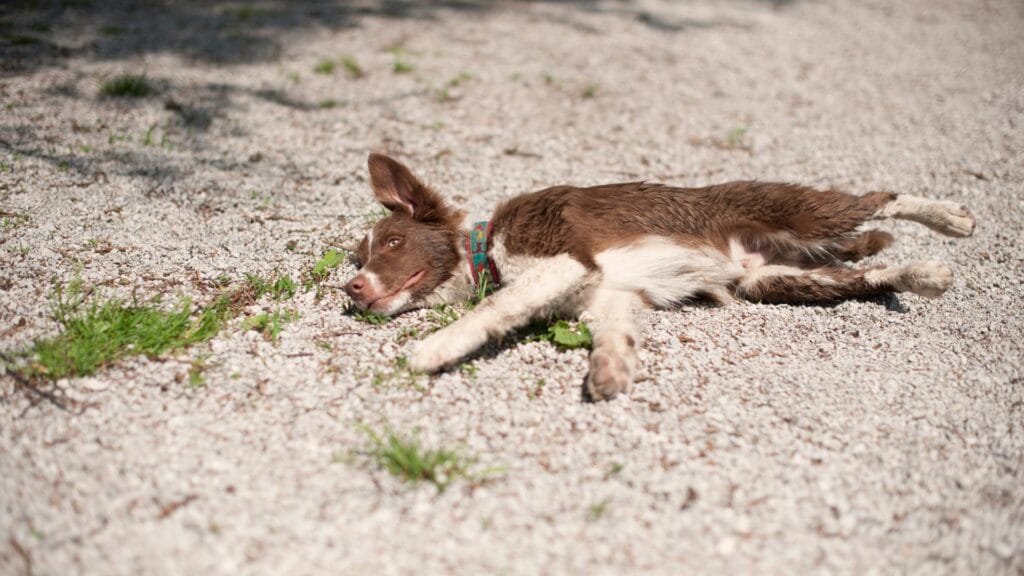
The goal is to encourage your dog to roll onto their side.
As soon as they reach the desired position, say “Yes!” or use your chosen marker word and immediately give the treat.
Don’t Force the Roll
This is extremely important.
Never physically push or roll your dog onto their back or side to make them perform the trick.
Some dogs are uncomfortable being handled around their abdomen, chest, legs, or neck. Forcing the movement can create anxiety and may make your dog reluctant to participate.
Instead, use the treat to guide the movement voluntarily.
Step 3: Reward the Side-Lying Position
At first, don’t worry about making the behavior look perfect.
If your dog rolls partly onto their side, reward the attempt.
After several repetitions, gradually become more selective.
For example:
- Dog lies down.
- You lure the head sideways.
- Dog shifts their shoulder.
- Dog rolls onto their side.
- You mark the behavior.
- Dog receives a treat.
Eventually, your dog will discover exactly which movement earns the reward.
This process is called shaping. You’re building the final behavior by rewarding small steps toward it.
Step 4: Add the “Bang” Hand Signal
Once your dog is consistently rolling onto their side, introduce a hand signal.
A popular signal is making a pretend finger gun with your hand.
Point your hand toward your dog and give your verbal cue.
You might say:
“Bang!”
Then guide your dog into the side-lying position.
As soon as your dog performs it, mark and reward.
Repeat this sequence consistently.
Over time, your dog will begin connecting the hand signal and verbal command with the behavior.
Step 5: Introduce the Verbal Command
Now it’s time to establish the cue.
Choose one phrase and stick with it.
Good options include:
- “Play dead”
- “Bang”
- “Dead”
- “Take a nap”
For clarity, “Play dead” is an excellent choice because it clearly describes the behavior you’re teaching.
Say the command immediately before giving the hand signal.
For example:
“Play dead!” → hand signal → dog rolls onto side → “Yes!” → treat
Repeat this sequence.
Eventually, your dog should begin responding to the verbal cue rather than relying entirely on the lure.
Step 6: Fade Out the Treat Lure
This is one of the most important stages of teaching how to teach dog to play dead.
Initially, your dog follows the treat because they want the food.
You don’t want your dog to believe that they only have to perform the trick when they can see a treat.
Start hiding the treat in your other hand.
Give the command and use the hand signal without holding food directly in front of your dog’s nose.
When your dog performs correctly, reward them from your other hand.
Gradually, the visible treat disappears from the process.
Your dog learns that performing the behavior, rather than seeing the food, earns the reward.
Step 7: Add Duration
A dog rolling onto their side is only part of the trick.
The classic “play dead” behavior usually involves remaining still for several seconds.
Begin with a very short duration.
Ask your dog to play dead.
Wait for approximately one second.
Then mark and reward.
Gradually increase the time:
- 1 second
- 2 seconds
- 3 seconds
- 5 seconds
- 8 seconds
- 10 seconds
Don’t increase the duration too quickly.
If your dog repeatedly gets up before you release them, you’ve probably increased the difficulty too fast.
Add a Release Cue
Teaching a release cue can make the exercise much clearer.
You might say:
“Okay!”
when your dog is allowed to move.
The sequence becomes:
“Play dead!” → dog lies on side → pause → “Okay!” → dog gets up
This teaches your dog that staying still continues until you give the release signal.
How to Teach Dog to Play Dead Without Confusing Your Dog
Dogs learn through consistent consequences.
If you sometimes reward your dog for lying on their side and sometimes reward them for immediately getting up, they may struggle to understand the final behavior.
Keep your criteria clear.
For the finished trick, you want:
Cue → roll onto side → remain still → release
Your dog doesn’t need to remain completely motionless forever. The goal is simply to teach a controlled, reliable behavior.
Common Mistakes When Teaching “Play Dead”
Even experienced dog owners can accidentally make trick training harder.
1. Moving the Treat Too Quickly
If you whip the treat backward, your dog may stand up, chase it, or become confused.
Move slowly.
Your dog should have enough time to follow the lure.
2. Physically Rolling Your Dog
Avoid pushing your dog into position.
The trick should be voluntary and rewarding.
If your dog resists rolling onto their side, stop and investigate why. They may simply need more gradual training, or they may dislike the surface or movement.
3. Training for Too Long
More training isn’t necessarily better.
Dogs can become mentally tired, frustrated, or distracted during lengthy sessions.
End the session while your dog is still interested.
4. Repeating the Command
Avoid saying:
“Play dead, play dead, play dead!”
while your dog is trying to work out what you want.
Instead, give the cue once.
Then help your dog succeed.
5. Rewarding Too Late
Timing matters.
When your dog performs the behavior correctly, mark it immediately.
A marker such as “Yes!” helps your dog understand exactly which behavior earned the reward.
6. Expecting Perfection Immediately
Your dog may initially roll halfway over.
That’s okay.
Reward progress and gradually raise your expectations.
Expert Tips for Teaching the Trick Faster
Keep Sessions Short
Several short sessions are usually more productive than one long session.
Try two or three sessions throughout the day.
Even 5 minutes of focused training can accomplish a lot.
Train on a Comfortable Surface
Hard or slippery flooring can make rolling uncomfortable.
A carpet, rug, dog mat, or other secure surface may make the exercise easier.
Use High-Value Rewards
If your dog isn’t particularly interested in ordinary kibble, use something more motivating during training.
Tiny pieces of cooked chicken or another dog-safe favourite can work well.
Keep portions small.
Train Both Sides
Some dogs naturally roll more easily onto one side.
Once your dog understands the trick, you can practise rolling toward the other side too.
This can improve body awareness and flexibility, although you shouldn’t force a movement that causes discomfort.
Reward Calmness
The final goal isn’t simply getting your dog onto their side.
You also want them to remain calm and controlled.
Reward your dog for staying in position until the release cue.
What If Your Dog Won’t Roll Onto Their Side?
Don’t assume your dog is being stubborn.
There are several possible reasons.
Your dog may:
- Not understand the lure
- Be distracted
- Dislike the surface
- Feel uncomfortable rolling
- Be physically restricted
- Find the movement unfamiliar
- Need smaller training steps
Try making the exercise easier.
Reward your dog for lying down, then reward a small head movement toward the side. From there, reward a shoulder shift, followed by a partial roll.
If your dog consistently appears uncomfortable when lying or rolling, stop the exercise and consider discussing the behavior with your veterinarian.
How Long Does It Take to Teach a Dog to Play Dead?
There is no universal timeline.
Some dogs understand the basic movement within a single session. Others need several days or weeks of short, consistent practice.
Your dog’s age, temperament, previous training, motivation, physical ability, and learning history can all affect progress.
Focus on improvement rather than speed.
A dog that learns slowly but enjoys the process is still making excellent progress.
Making “Play Dead” More Reliable
Once your dog understands the trick, start practising in different locations.
Try:
- The living room
- The backyard
- A quiet park
- Another room
- Around familiar family members
Increase distractions gradually.
Don’t jump from a quiet bedroom straight into a crowded dog park.
Your dog may know the behavior perfectly in your kitchen but struggle when the environment changes.
That’s normal.
Can Puppies Learn to Play Dead?
Yes, puppies can learn simple tricks using positive reinforcement.
However, keep puppy training sessions especially short.
Young dogs have limited attention spans and are still developing physically and mentally.
Avoid repetitive rolling exercises that could cause unnecessary strain, and never force a puppy into a position.
The objective should be building communication and confidence, not simply producing a cute trick.
FAQ: Teaching a Dog to Play Dead
How old should a dog be to learn to play dead?
There isn’t one specific age when a dog must learn this trick.
Puppies can begin learning basic behaviors through reward-based training, while adult and senior dogs can also learn new tricks.
The key consideration is your individual dog’s physical comfort and ability to perform the movement safely.
Is “play dead” hard to teach a dog?
For many dogs, the trick becomes fairly straightforward once they understand the rolling movement.
The most difficult part is often communicating exactly what you want.
Breaking the behavior into smaller steps, rewarding immediately, and gradually removing the food lure can make the process much easier.
Can you teach a dog to play dead without treats?
Yes.
Treats are particularly useful during the early learning stages, but they’re not the only possible reward.
You can eventually reinforce the behavior with praise, toys, play, attention, or other rewards your dog values.
Food often makes initial training easier because it provides a fast and clear reward.
Final Thoughts: How to Teach Dog to Play Dead Successfully
Learning how to teach dog to play dead is less about performing a clever trick and more about learning how to communicate with your dog clearly.
Start with down, guide your dog gently onto their side, reward every step toward the finished behavior, then gradually introduce the “play dead” command, hand signal, duration, and release cue.
Keep sessions short. Stay patient. Never force your dog into position.
Most importantly, remember that training should strengthen the relationship between you and your dog.
Once your dog understands play dead, don’t stop there. Use the same reward-based principles to teach another trick, improve an existing command, or work on a useful everyday behavior.
A few minutes of positive training each day can build skills, confidence, and a stronger bond with your dog.